

Sustainable Web Development Life Cycle and Digital Carbon Footprint
The global tech ecosystem is often perceived as a clean, weightless cloud. However, the internet is not invisible; it is anchored to a massive, energy-intensive physical infrastructure. Millions of servers spinning inside hyper-scale data centers, vast fiber-optic routing networks buried beneath oceans, and billions of client smartphones and laptops all demand continuous electrical power.
The global digital footprint emits a volume of greenhouse gases equivalent to or exceeding that of the commercial aviation industry. As digital transformation accelerates, web developers and technology executives must confront the environmental realities of their creations.
By transforming the traditional Web Development Life Cycle (WDLC) into a sustainable framework, engineering teams can systematically measure, isolate, and radically reduce the digital carbon footprint of their applications without compromising user experience.
Quantifying the Digital Carbon Footprint: The Mechanics of Data Emissions
To optimize web applications for sustainability, developers must understand how digital assets consume energy. Digital carbon … READ MORE

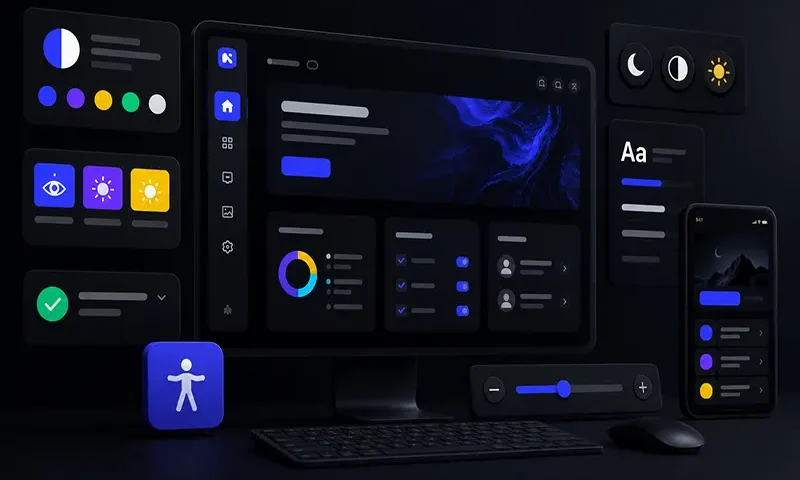
Inclusive Design Patterns for High Contrast Dark Mode
Dark mode is frequently treated as a trendy aesthetic preference, a sleek marketing asset, or a useful layout option to save mobile battery life. However, for millions of users worldwide, a dark interface is not an aesthetic luxury; it is a functional necessity. Individuals with specific visual or neurological conditions—such as severe photophobia (extreme light sensitivity), cataracts, ocular albinism, or traumatic brain injuries—experience physical pain, blurred vision, or immediate cognitive fatigue when navigating traditional bright interfaces.
Unfortunately, many standard dark themes fail foundational web accessibility compliance. Simply swapping a white canvas for a dark one often introduces muddy contrast levels, vibrating neon accents, or a complete loss of structural layout hierarchy when shadows disappear. Building an inclusive dark mode requires implementing adaptive, high-contrast design patterns that blend Web Content Accessibility Guidelines (WCAG) AAA compliance with modern CSS token architectures, ensuring interfaces remain highly readable and comfortable for all users.
The
… READ MORE

Offshore Anonymous VPS Hosting with Crypto Payment Options
In an era of ubiquitous data harvesting, shifting regulatory landscapes, and centralized network surveillance, maintaining true digital sovereignty has become a complex operational challenge. For cybersecurity professionals, international founders, journalists, and privacy-conscious sysadmins, standard cloud infrastructure providers present a distinct point of failure. Conventional hosts require invasive identity verification, log expansive metadata trails, and operate under jurisdictions prone to overreaching data seizures.
Protecting sensitive intellectual property, maintaining operational security, and safeguarding free expression requires a specialized approach to infrastructure design. Offshore anonymous Virtual Private Server (VPS) hosting addresses this need. True data sovereignty is achieved by combining three core structural pillars: deploying infrastructure within legally protective offshore jurisdictions, maintaining total account anonymity through non-KYC onboarding, and utilizing zero-knowledge cryptographic payment rails.
The Legal Engineering of Offshore Jurisdictions
In server architecture, the term “offshore” does not imply illicit evasion or operating outside the rule of law. Instead, it refers to the … READ MORE

Agile Web Development Life Cycle for Remote Distributed Teams
Distributed engineering is no longer a temporary operational compromise or a localized hiring perk; it is a permanent competitive advantage. Building a fully remote or globally distributed engineering organization allows companies to source top-tier technical talent from anywhere on earth, lowering geographic overhead while fostering diverse problem-solving perspectives.
However, a core friction point persists inside this model: the Agile methodology was originally conceived on the assumption of physical co-location. The original Agile Manifesto favored physical whiteboards, daily standups conducted in a literal circle, and instant desk-side debugging sessions. Forcing a distributed engineering team spread across multiple continents into a synchronous, meeting-heavy Scrum structure leads to calendar exhaustion, communication silos, and a massive drop in software velocity.
Successfully executing the Agile Web Development Life Cycle (WDLC) across distributed time zones requires transitioning from synchronous dependency loops to intentional asynchronous processes, backed by deterministic tooling and radical documentation.
Re-Engineering Agile Rituals for
… READ MORE

Organic Anti-Grid Layouts for Creative Brand Websites
The modern web has become structurally monotonous. Walk through the digital storefronts of luxury fashion houses, independent design studios, and enterprise SaaS platforms, and you will encounter the same predictable architecture: rigid geometric boxes, symmetrical card modules, and uniform container widths. The massive dominance of standard responsive frameworks has commoditized layout design, reducing the vibrant canvas of the browser into a series of predictable templates. While this homogenization offers predictable patterns for information retrieval, it strips creative brands of their unique personality.
To stand out in a crowded digital landscape, forward-thinking brands are shifting toward organic, anti-grid layouts. By embracing asymmetrical structures, layered fluid depths, overlapping typography, and curvilinear motion paths, designers can break free from traditional container boundaries. When executed correctly, anti-grid web design allows creative brands to cultivate a distinct visual identity and evoke deep emotional resonance, transforming a standard digital store or portfolio into an immersive, … READ MORE